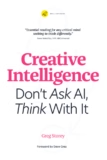
a lot of professionals operate in a single cognitive gear: convergent thinking. They jump immediately to solutions, rush toward decisions, and mistake speed for intelligence. They've been trained by decades of quarterly reviews and daily standups to believe that having an answer—any answer—is better than exploring the problem space. This isn't intelligence. It's algorithmic behavior. And it's exactly why companies are finding it so easy to replace middle management with AI systems. If you only know how to converge, you're just a slower, more expensive algorithm.
Decision-Learning Loops: • Use AI to structure important decisions more systematically • Apply those decisions in real contexts • Use AI to analyze outcomes and extract lessons • Apply those lessons to improve future decisionmaking Meta-Learning Patterns: • Identify recurring decision types in your work • Develop AI-assisted frameworks for each type • Track patterns across decisions to improve frameworks • Build personal decision intelligence over time
"I'm choosing between [Option A] and [Option B]. Help me analyze the trade-offs by weighing them against these criteria: [list your specific criteria]. What am I gaining and giving up with each choice, and what hidden costs might I be missing?"
"I'm considering [specific decision]. Walk me through three different scenarios: best case, worst case, and most likely case. For each scenario, what would the situation look like in 6 months, 1 year, and 3 years?"
"I've been reading five different articles about employee retention strategies. Help me identify the common themes, contradictions, and patterns across all these sources. What are the key principles that emerge when you synthesize this information?"
It's about professional survival in a world where work is being restructured around who can think with machines versus who just follows instructions from them.
Invest your time when AI outputs could affect revenue, risk, or reputation—these high-stakes areas demand preparation. Also prioritize fields where you're currently stuck, avoiding collaboration entirely because you can't validate results. Look for areas where you already have knowledge fragments to build on, making the path to competence shorter. Focus on subjects where you'll need to explain or defend AI-generated work to stakeholders. Skip preparation when the area remains peripheral to your core work or when failure consequences are minimal. Don't invest time where true experts are readily available for validation, and avoid extensive preparation when you're just exploring or experimenting with new ideas.
Creative Work: Instead of accepting final outputs, ask AI to show you its reasoning process so you can guide the direction. Clarify what assumptions it's making about your audience, brand, or goals that you should confirm or correct. Request multiple approaches so you can choose the direction that fits your specific context.
Complex Analysis: Always ask AI to explain its methodology step-by-step before it analyzes data so you can follow the reasoning. Have it show you the key assumptions it's making and how they might affect conclusions. Request that complex analysis be broken into smaller parts you can verify independently.
Business Strategy: Start by asking AI to explain market analysis fundamentals and what indicators signal real opportunities versus vanity metrics. Learn what solid business cases look like compared to wishful thinking or incomplete analysis.
Great thinking isn't about getting to the answer fastest. It's about exploring the problem space thoroughly enough to find the best answer—or sometimes, to redefine the question itself. AI allows us to accelerate this exploratory process. It lets us rapidly test multiple approaches, challenge our assumptions, and refine our thinking in real time. But only if we engage with it as a collaborative partner rather than a vending machine.
Great thinking isn't about getting to the answer fastest. It's about exploring the problem space thoroughly enough to find the best answer—or sometimes, to redefine the question itself. AI allows us to accelerate this exploratory process. It lets us rapidly test multiple approaches, challenge our assumptions, and refine our thinking in real time. But only if we engage with it as a collaborative partner rather than a vending machine.